
Ingrown Toenail Correction & Toenail Braces in Rockville, MD
Painless, anesthesia-free, non-surgical correction of ingrown and involuted toenails using advanced bracing systems. Serving Rockville, Bethesda, Gaithersburg, Silver Spring and the wider Montgomery County area.
The Safe, Non-Surgical Alternative to Ingrown Toenail Surgery
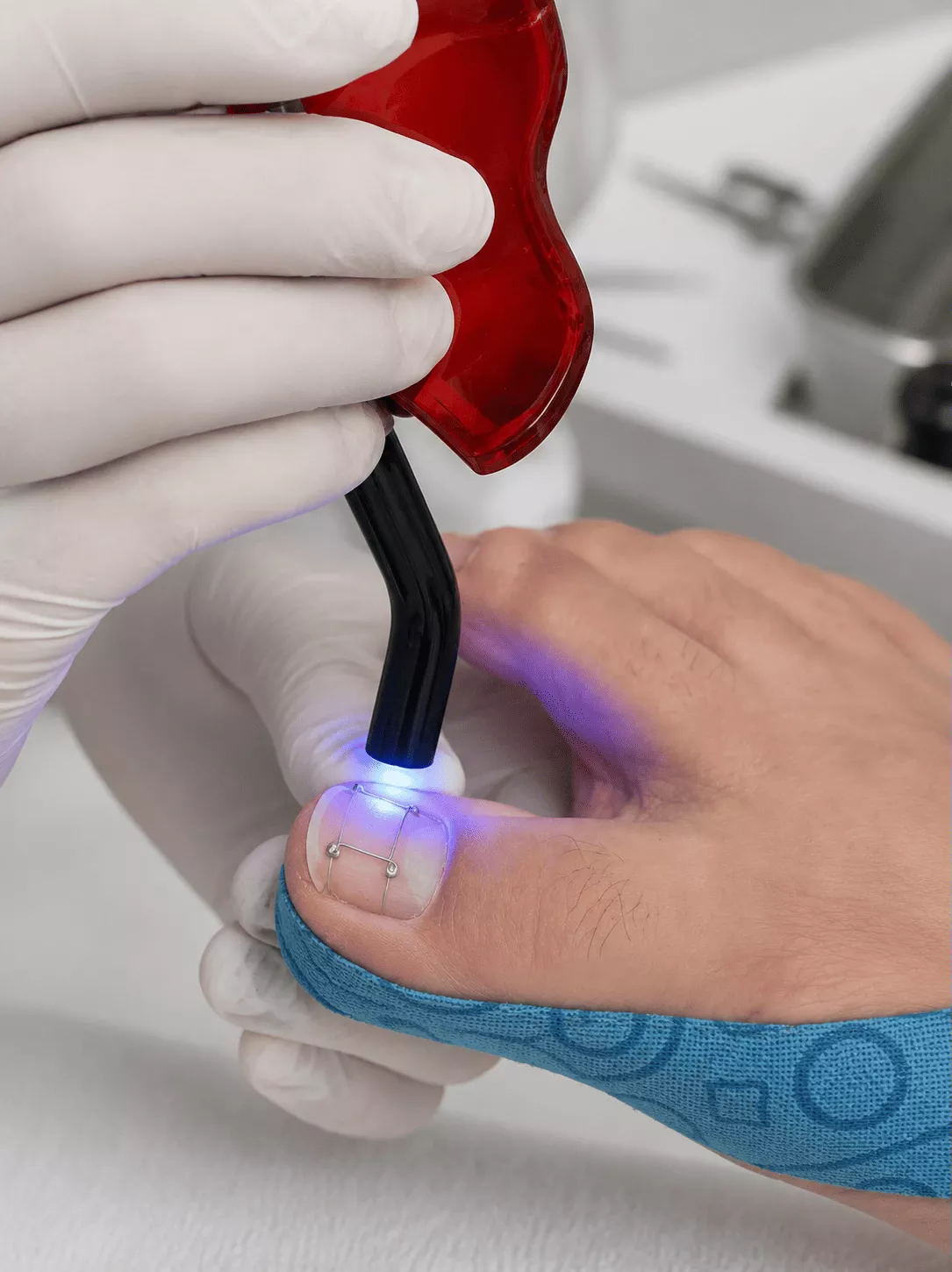
If you suffer from involuted (highly curved) or ingrown toenails, surgery is no longer your only option. Toenail bracing works on a similar principle to dental braces: a custom-tensioned device is bonded across the nail plate, gently lifting the edges and easing pressure on the surrounding skin.
The application is entirely painless, requires no anesthesia, and there is no recovery time. The correction happens gradually over several weeks, safely reshaping the nail plate and guiding it toward healthier growth. We offer multiple advanced systems — Titanium Thread, Unibrace, Frezera, and B/S Systems — so we can match the correction precisely to your nail's thickness and degree of curvature.
What Is an Ingrown Toenail?
An ingrown toenail (onychocryptosis) happens when the edge or corner of a toenail grows down into the surrounding skin instead of straight forward. It most commonly affects the big toe and causes pain, redness, swelling, and sometimes infection.
An involuted toenail is closely related — the nail itself is excessively curved or pincer-shaped, pressing on the side walls of the nail bed even before it pierces the skin. Both conditions respond very well to bracing because the technique addresses the root cause: the abnormal curvature of the nail plate.
Typical symptoms include:
- • Sharp pain at the edge of the toenail, especially with shoe pressure
- • Redness and swelling along the side of the nail
- • Tender, hardened skin around the nail edge
- • Recurring infection or pus discharge
- • Visibly curved or pincer-shaped nail plate
Common causes: improper toenail trimming (cutting corners too short or rounded), tight shoes, repetitive trauma from running or hiking, genetic nail shape, fungal thickening that distorts growth, and recovery from prior nail surgery.
Why Choose Toenail Bracing?
- No surgery, no needles: Completely non-invasive, anesthesia-free alternative to ingrown nail removal.
- Immediate relief: Pressure and discomfort drop noticeably right after application.
- Zero downtime: Wear normal shoes and continue daily activities immediately.
- Long-term realignment: Trains the nail to grow flatter, reducing the chance of recurrence.
The Application Process
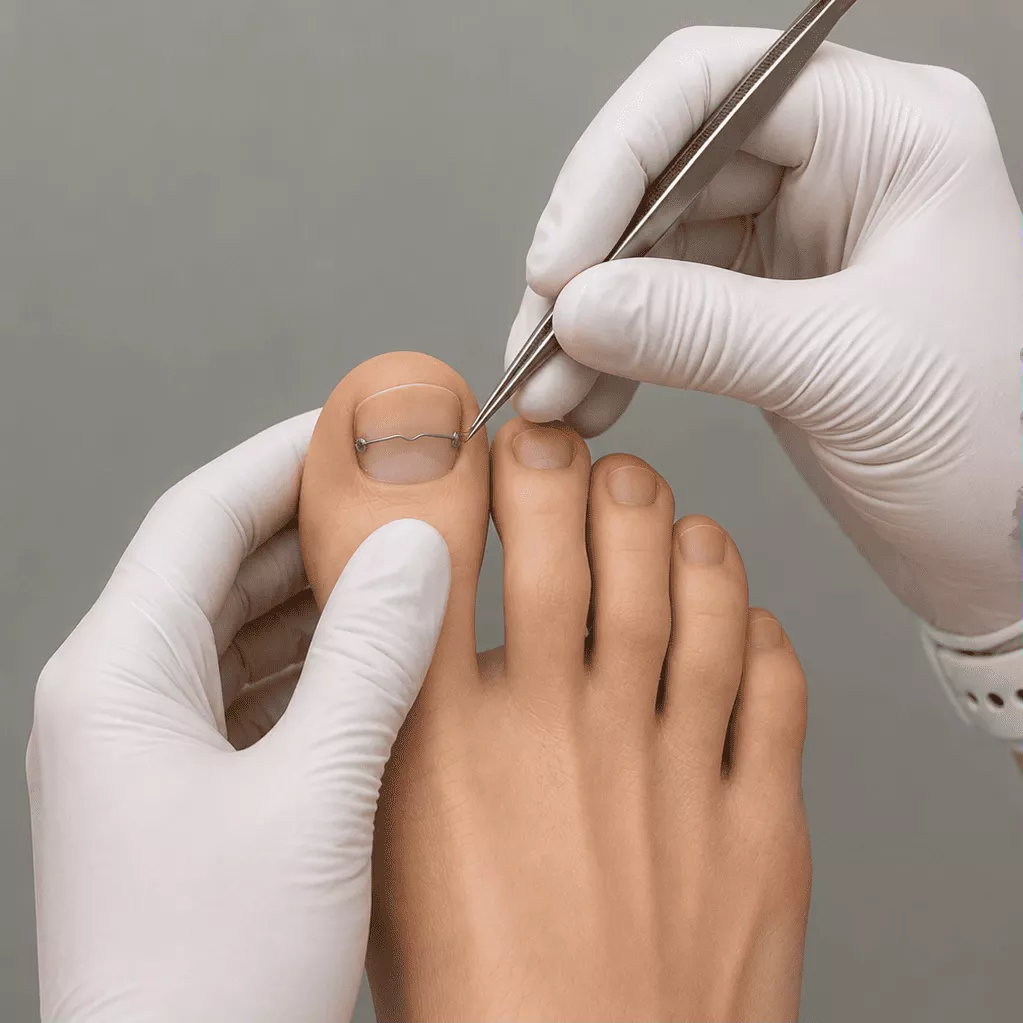
Structural Assessment
We evaluate the thickness, curvature, length, and surrounding tissue of the involuted nail to select the most effective bracing system for your specific anatomy.
Preparation & Custom Application
The nail plate is cleansed and prepped. The chosen brace (e.g., Titanium Thread or Unibrace) is custom-fitted and securely bonded — it immediately acts as a spring, lifting the nail edges.
Gradual Correction & Reinstallation
As the nail grows, the brace travels with it. Over several weeks the nail straightens. Periodic reinstallation maintains optimal tension until correction is complete.
The Four Bracing Systems We Offer
Different ingrown toenail cases need different bracing approaches. Here is how each of the four systems works, and which case it suits best.
B/S System (Plastic)
From $70A thin, transparent fiberglass-reinforced strip bonded to the surface of the nail. Best for mild-to-moderate curvature on healthy nails, athletes, and anyone who wants the brace to be visually invisible. Quickest and most affordable option.
Titanium Thread
$150A flexible titanium wire bonded across the nail with composite resin. Ideal for thicker nails, ridged nails, and cases where the B/S system would not provide enough tension. Holds correction strongly while still being comfortable in closed shoes.
Unibrace
$250A precision metal brace hooked under both side edges of the nail and tensioned across the top. Best for severe pincer-shaped or deeply involuted nails where strong, immediate mechanical lift is required. Reusable through follow-up adjustments.
Frezera
$250A modern Italian system using a custom-shaped, spring-tensioned wire combined with composite anchors. Excellent for complex cases that have failed other approaches, post-surgical regrowth, and athletes whose nails experience high mechanical stress.
We assess your nail at the start of the visit and recommend the right system. You don't need to decide in advance — we will explain options that fit your situation.
Toenail Bracing vs Ingrown Toenail Surgery
Many people come to us after being told their only option is surgery (matrixectomy or partial nail avulsion). Here is an honest comparison so you can decide what fits your situation.
| Factor | Toenail Bracing | Surgical Removal |
|---|---|---|
| Anesthesia required | None | Local injection |
| Pain during procedure | None | Numbed during, sore after |
| Downtime | None — walk out, wear normal shoes | 1–2 weeks limited activity |
| Nail loss | No — the nail is preserved | Partial or full nail removed |
| Time to relief | Immediate, full correction in weeks | Days for healing, weeks for regrowth |
| Recurrence risk | Low if correction held to completion | Possible regrowth in distorted shape |
| Best for | Most non-infected curved & ingrown nails | Acute infection, severe damage, failed bracing |
Bracing is usually the better first step — non-invasive, no downtime, and the nail is preserved. Surgery makes sense when there is acute infection, severe nail damage, or when bracing has failed. If you are unsure which fits your case, we will tell you honestly during the assessment.
When You Should See a Podiatrist Instead
Our bracing service is cosmetic and non-medical. There are situations where you should see a licensed podiatrist or physician before a bracing appointment:
- Active bacterial infection — pus, severe redness, fever, or red streaks moving up the foot.
- Diabetes, peripheral neuropathy, or compromised circulation.
- Pain so severe you cannot bear weight on the foot.
- Granulation tissue (a fleshy red lump) growing alongside the nail.
- Children under 12, or anyone who has had multiple failed bracing or surgical attempts.
For mild-to-moderate involution or recurring ingrown nails without acute infection, bracing is usually the right first step.
Related Foot Care Services
Ingrown nails often come together with other foot concerns. These complementary services may also help:
Medi Pedicure (Specialized Foot Care)
For thickened nails, painful calluses, and complex foot care that often accompany ingrown issues.
Toenail Fungus Solution
Fungal thickening often distorts nail growth and leads to ingrown problems. Cosmetic clearance complements bracing.
Initial Consultation
Not sure if bracing is right for you? Start with an assessment of your nails and a personalized care plan.
Wellness Pedicure
Waterless maintenance pedicure that supports healthy nail trimming technique — key to preventing recurrence.
Three Typical Bracing Cases
Composite examples drawn from common client patterns. Details are generalized — no real names or identifying information.
"Third recurrence in two years"
Right big toenail, persistent ingrown edge despite two prior podiatrist visits with partial nail-edge removal. Pattern was clear — the underlying nail shape kept producing the problem. Came specifically to try a non-surgical correction.
Path: Composite brace fitted at first visit, replaced at week 6. By month 4, nail edge had grown out correctly aligned for the first time in years. No surgical scar, no down time. Returned at month 6 for a final check; no further bracing needed.
"My podiatrist wanted to avoid surgery"
Chronic ingrown big toenail on the left foot in a controlled diabetic. Her podiatrist explicitly wanted to avoid any surgical incision because of slower diabetic healing. Referred for bracing as a first-line correction.
Path: 3TO wire brace, replaced once. Coordinated visit cadence with her endocrinologist's check-up schedule. By month 5 the nail had reshaped sufficiently; no surgery required.
"It came back six months after the surgery"
Had partial nail avulsion 9 months prior. Ingrown edge re-appeared as the nail regrew because the underlying nail-shape issue was never corrected — just the symptom was excised. Frustrated with the prospect of another surgical procedure.
Path: COMBIped composite brace fitted while the nail was still mid-regrowth. The reshaping happened concurrently with the regrowth, so the new nail came in correctly aligned from the start. Single brace cycle was enough.
Frequently Asked Questions
Does toenail bracing hurt?
How long does it take to fix an ingrown toenail with braces?
Can you fix an ingrown toenail without surgery?
Can a nail salon safely remove ingrown toenails?
Which brace system is best for me?
How much does ingrown toenail correction cost in Rockville?
Can I wear normal shoes with a brace on?
Do you serve clients from Baltimore?
*Disclaimer: MedPedicure Center provides cosmetic foot care and aesthetic restoration services. We do not diagnose, treat, or cure medical conditions. Toenail bracing is a non-invasive cosmetic correction technique; it is not a medical procedure. Clinical terms used on this page are for general informational context only. For acute bacterial infection, severe pain, diabetic complications, or any condition that may require medical intervention, please consult a licensed podiatrist or physician before booking.
Brace Options & Pricing
We help you choose the right brace at the start of your visit.